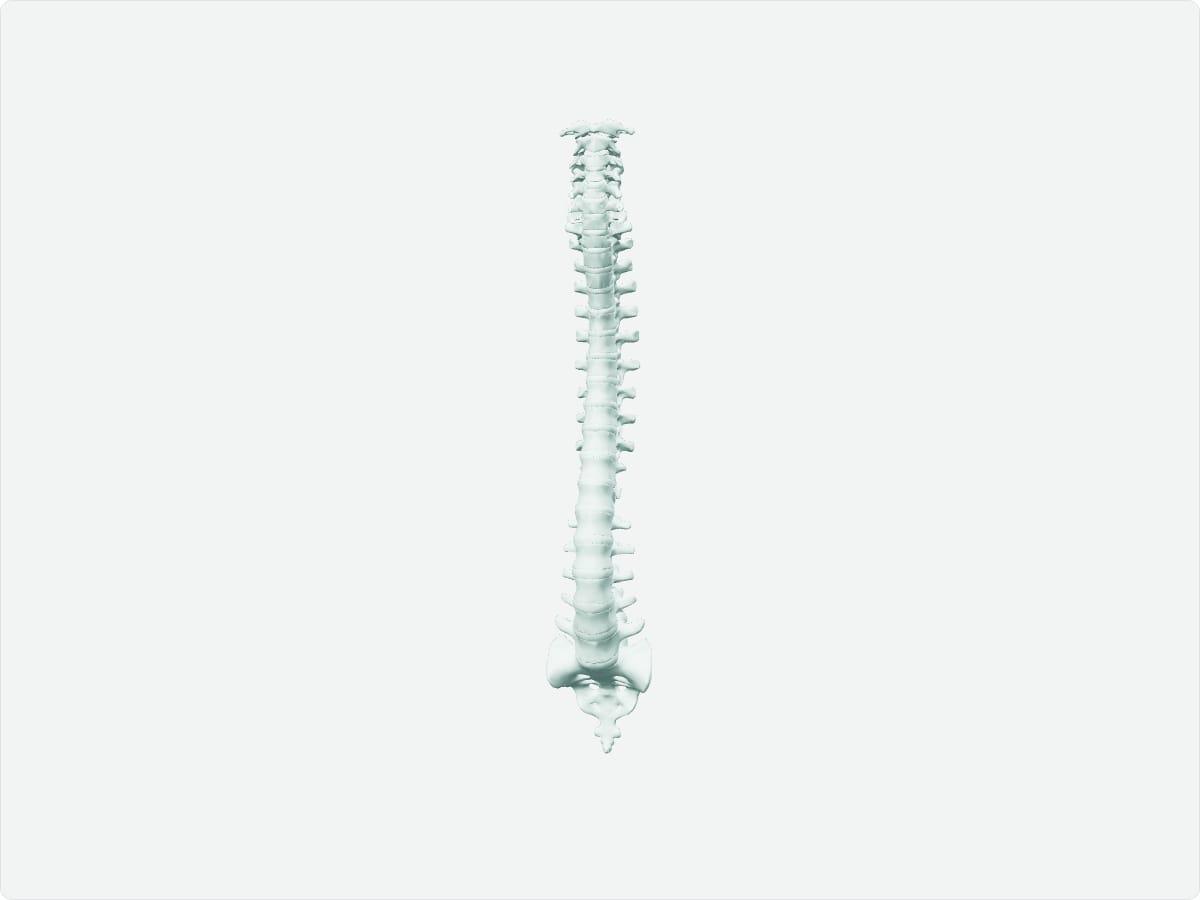
Vertebral column: anatomy, landmarks and articulations
Also called: spine, backbone, spinal column
Quick answer
The vertebral column is the flexible bony axis of the trunk. It has 24 movable vertebrae (7 cervical, 12 thoracic and 5 lumbar) plus the sacrum and coccyx. It protects the spinal cord, supports the head and trunk and provides attachment for the ribs and back muscles.
Key facts
Type
Series of irregular bones separated by intervertebral discs.
Location
Posterior midline of the trunk, from the skull to the pelvis.
Landmarks
Vertebral body, arch, spinous and transverse processes, articular processes, intervertebral foramina, cervical, thoracic, lumbar and sacral curvatures.
Articulations
Skull (atlanto-occipital), ribs (thoracic vertebrae), hip bones (via the sacrum).
Muscle attachments
Erector spinae, multifidus, psoas major, trapezius, rhomboids, and many others.
3D model: BodyParts3D (CC BY 4.0), adult male reference anatomy. Highlighted structure shown with nearby bones for context.
About the vertebral column
The spine has four curves: cervical and lumbar lordosis and thoracic and sacral kyphosis. The curves increase resilience and help balance the head over the pelvis.
Clinical relevance
Scoliosis is a lateral curvature of the spine.
Lumbar disc herniation commonly affects L4-L5 and L5-S1 and can compress nerve roots.
Frequently asked questions
How many vertebrae are there?
24 movable vertebrae plus the fused sacrum and coccyx.