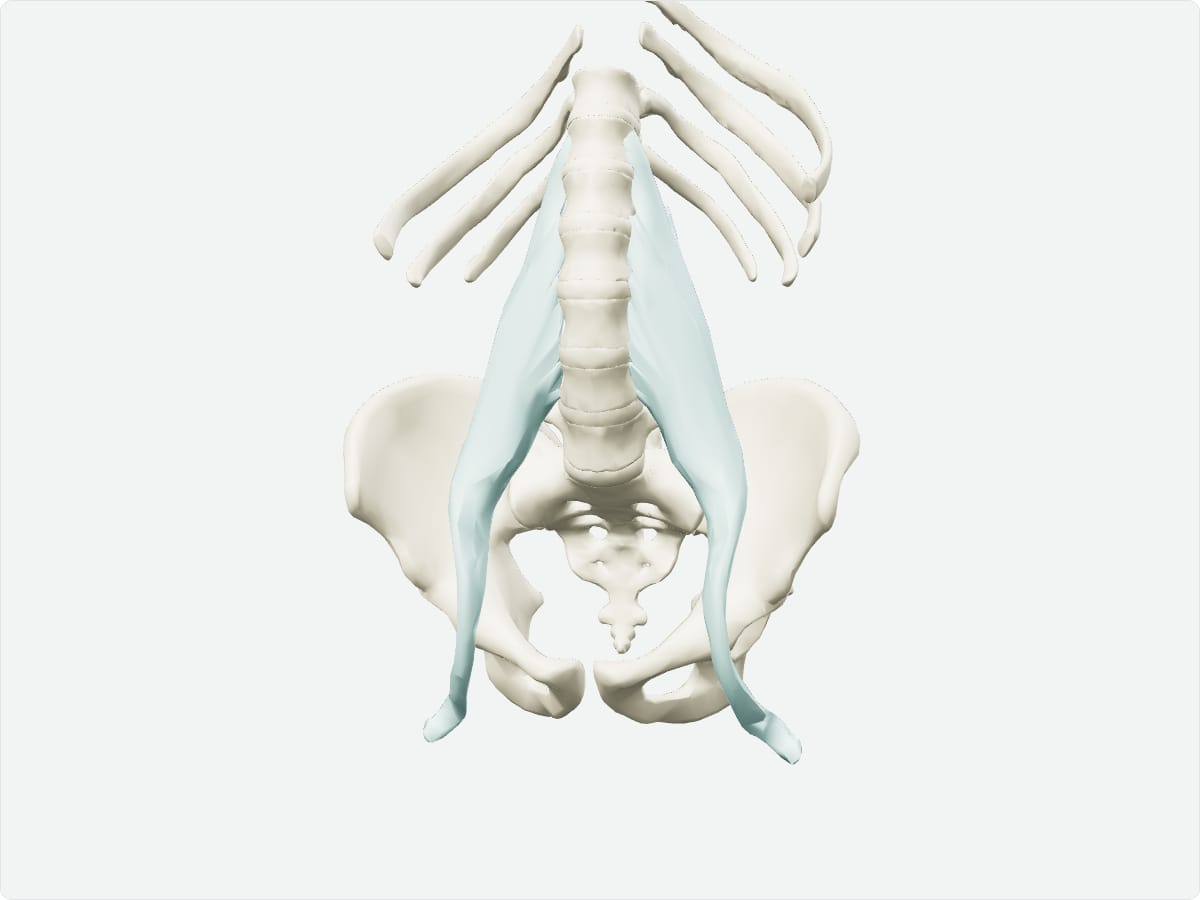
Psoas major: origin, insertion, nerve supply and action
Also called: iliopsoas (with iliacus)
Quick answer
The psoas major is a long muscle on the back wall of the abdomen. It arises from the lumbar vertebrae and their discs and inserts with iliacus on the lesser trochanter of the femur. Branches from the lumbar plexus supply it, and it is the main flexor of the hip.
Key facts
Origin
Sides of the bodies and intervertebral discs of T12 to L4 and the transverse processes of L1 to L5.
Insertion
Lesser trochanter of the femur (by the common iliopsoas tendon).
Innervation
Anterior rami of L1-L3.
Blood supply
Lumbar branches, iliolumbar artery and the external iliac artery.
Action
Flexes the thigh at the hip; with the thigh fixed it flexes the lumbar spine.
3D model: BodyParts3D (CC BY 4.0), adult male reference anatomy. Highlighted structure shown with nearby bones for context.
About the psoas major
With the iliacus it forms the iliopsoas, the strongest hip flexor. The lumbar plexus lies within the muscle and the genitofemoral nerve emerges on its anterior surface.
Clinical relevance
A psoas abscess may track down along the muscle sheath and present in the groin.
Tight hip flexors, including the psoas, can increase lumbar lordosis.
Frequently asked questions
What is the iliopsoas?
The combined psoas major and iliacus, which share a tendon inserting on the lesser trochanter and flex the hip.