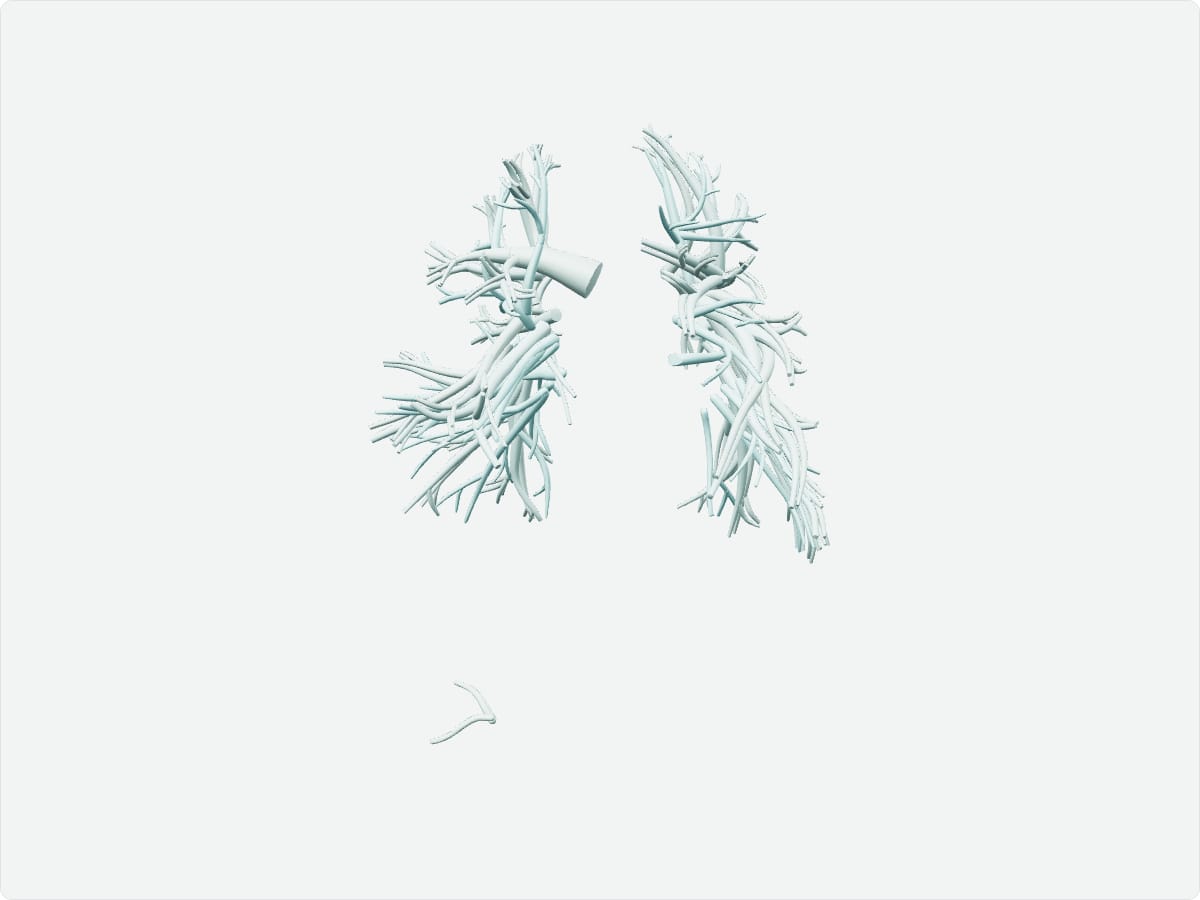
The lungs are the paired organs of gas exchange in the chest. The right lung has three lobes and the left has two, with a cardiac notch that accommodates the heart. Air passes through bronchi into alveoli, where oxygen enters the blood and carbon dioxide leaves it. Each lung is enclosed by a pleural sac.
Key facts
Location
Thoracic cavity on either side of the mediastinum, each in its own pleural cavity.
Structure
Right lung: superior, middle and inferior lobes (two fissures). Left lung: superior and inferior lobes (one fissure), lingula and cardiac notch; bronchopulmonary segments.
Function
Gas exchange between inspired air and pulmonary capillary blood.
Blood supply
Pulmonary arteries carry deoxygenated blood to the lungs; pulmonary veins return oxygenated blood; bronchial arteries supply the lung tissue itself.
Innervation
Pulmonary plexus: vagus nerve (bronchoconstriction) and sympathetic fibres (bronchodilation).
3D model: BodyParts3D (CC BY 4.0), adult male reference anatomy. Highlighted structure shown with nearby bones for context.
About the lungs
The atlas model shows the bronchial tree and pulmonary vessels together with the lung lobes. The right lung is larger and slightly shorter than the left, which is displaced by the heart.
Clinical relevance
Pneumothorax, or air in the pleural cavity, causes partial or complete lung collapse.
Pulmonary embolism occurs when a clot blocks a pulmonary artery.
Frequently asked questions
How many lobes does each lung have?
The right lung has three lobes and the left lung has two.
Why is the left lung smaller?
The heart and its apex occupy space on the left, creating the cardiac notch.