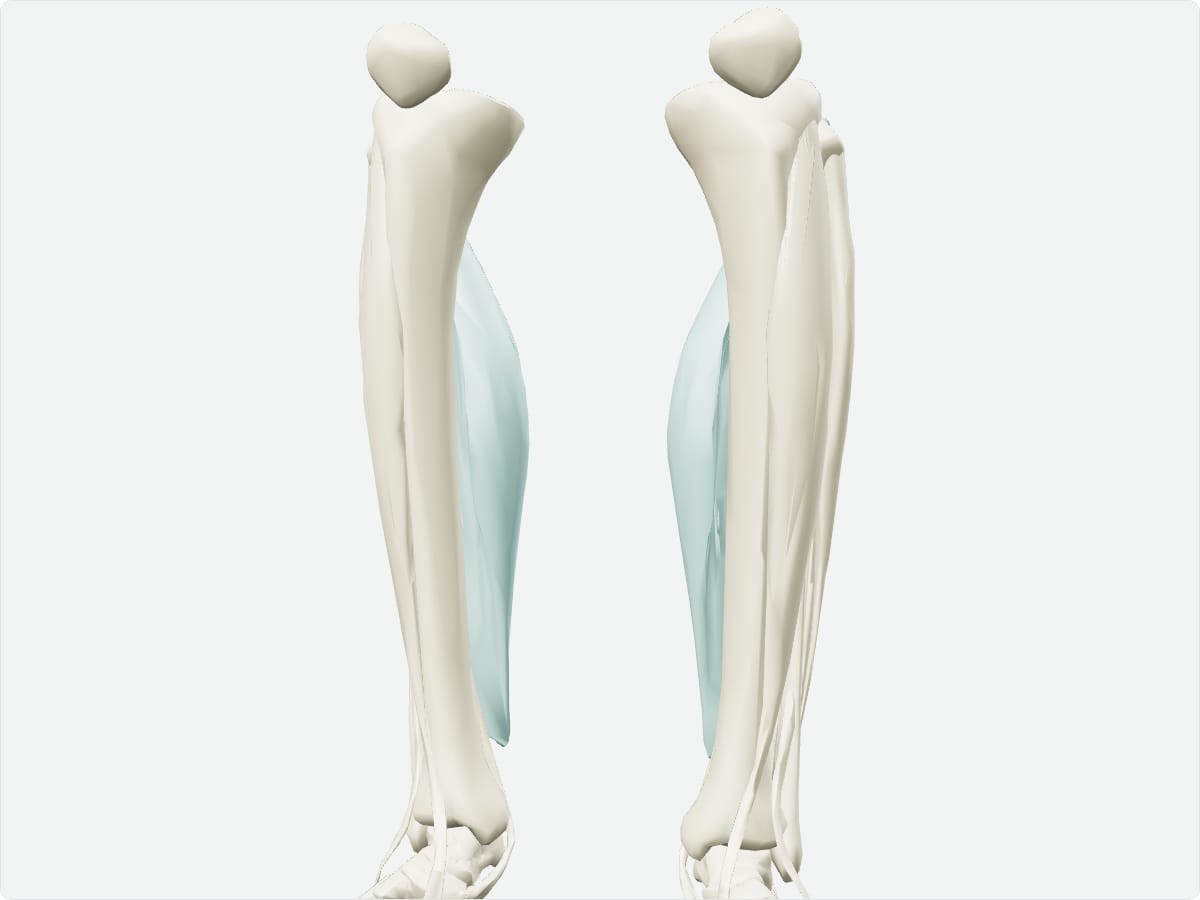
Soleus: origin, insertion, nerve supply and action
Quick answer
The soleus is a broad, flat muscle deep to the gastrocnemius in the calf. It arises from the upper fibula and the soleal line of the tibia and inserts on the calcaneus through the calcaneal (Achilles) tendon. The tibial nerve supplies it, and it plantarflexes the ankle whatever the position of the knee.
Key facts
Origin
Posterior aspect of the head and upper fibula, soleal line and medial border of the tibia, and the tendinous arch between them.
Insertion
Posterior surface of the calcaneus via the calcaneal tendon.
Innervation
Tibial nerve (S1-S2).
Blood supply
Posterior tibial and fibular arteries.
Action
Plantarflexes the ankle and stabilises the leg on the foot when standing.
3D model: BodyParts3D (CC BY 4.0), adult male reference anatomy. Highlighted structure shown with nearby bones for context.
About the soleus
The soleus is rich in slow-twitch fibres and contracts constantly during standing. Its contractions squeeze the deep veins of the calf, so it acts as a peripheral venous pump.
Clinical relevance
Deep vein thrombosis frequently begins in the soleal veins.
Soleus contracts even with the knee bent, unlike gastrocnemius.
Frequently asked questions
How does the soleus differ from the gastrocnemius?
The soleus crosses only the ankle, so it works with the knee bent or straight, while the gastrocnemius crosses the knee and the ankle.