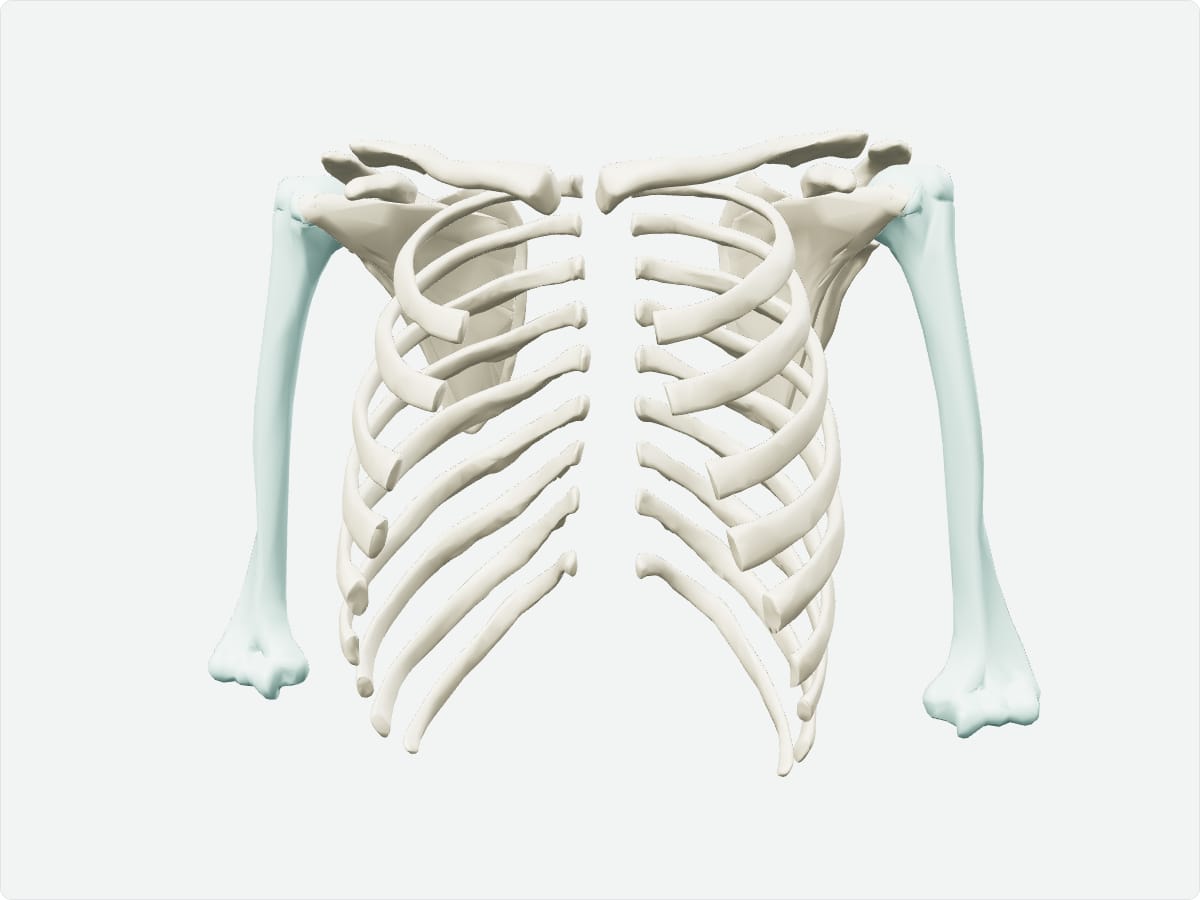
The humerus is the long bone of the upper arm. Its rounded head articulates with the glenoid cavity of the scapula at the shoulder, and its distal end forms the elbow joint with the radius and ulna. It has a surgical neck, greater and lesser tubercles, a deltoid tuberosity and a radial groove that carries the radial nerve.
3D model: BodyParts3D (CC BY 4.0), adult male reference anatomy. Highlighted structure shown with nearby bones for context.
About the humerus
The proximal humerus has the greatest range of motion of any long bone because the shoulder is a ball-and-socket joint with a shallow socket. The radial nerve and profunda brachii artery wind along the radial groove on the posterior shaft.
Clinical relevance
A fracture of the surgical neck risks injury to the axillary nerve.
A midshaft fracture can damage the radial nerve in the radial groove, causing wrist drop.
Supracondylar fractures are common in children and can threaten the brachial artery.
Frequently asked questions
Which nerve is at risk in a midshaft humerus fracture?
The radial nerve, because it lies against the bone in the radial groove.
What joints does the humerus form?
The glenohumeral (shoulder) joint with the scapula, and the elbow joint with the radius and ulna.