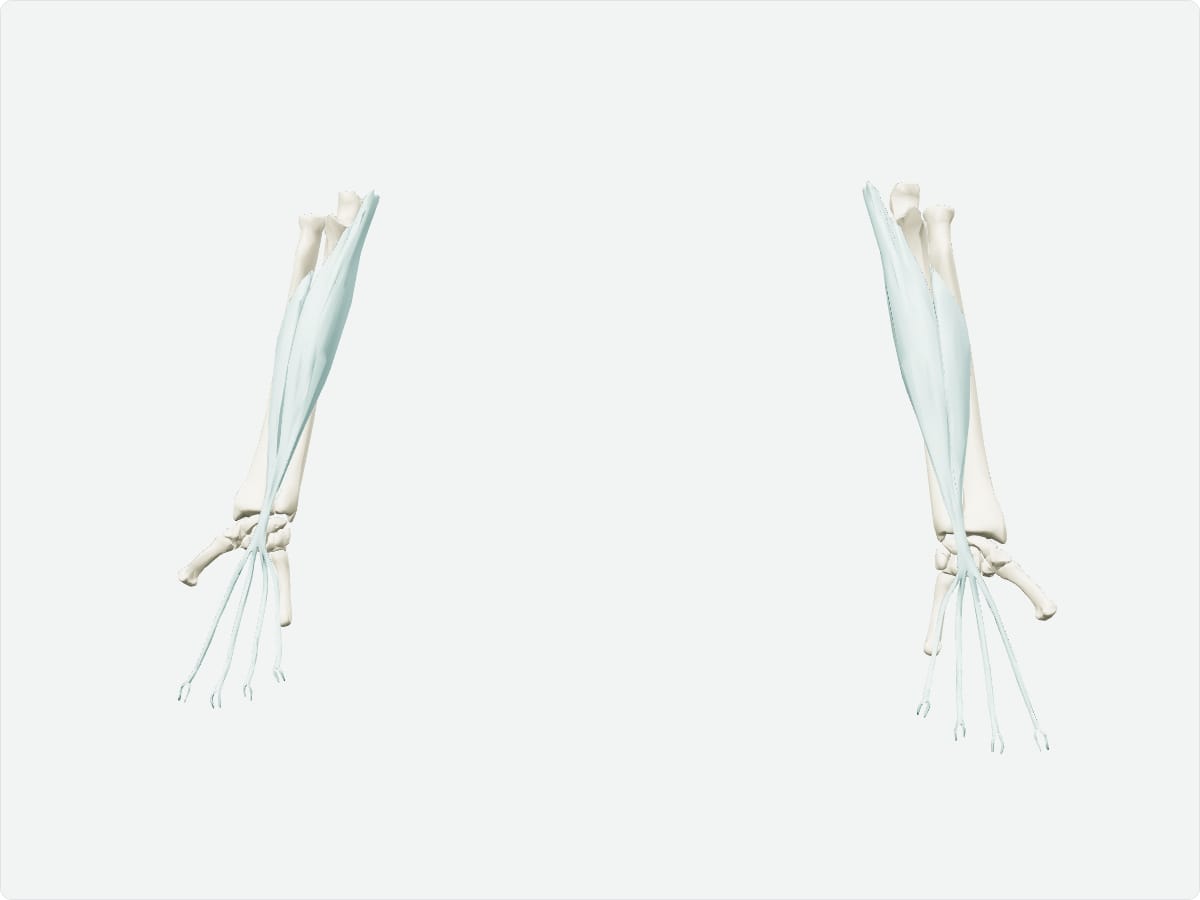
Flexor digitorum superficialis: origin, insertion, nerve supply and action
Also called: FDS
Quick answer
The flexor digitorum superficialis is the middle-layer flexor of the fingers. It arises from the medial epicondyle, ulna and radius and splits into four tendons that insert on the middle phalanges of digits two to five. The median nerve supplies it, and it flexes the proximal interphalangeal joints.
Key facts
Origin
Humeroulnar head: medial epicondyle and coronoid process. Radial head: anterior oblique line of the radius.
Insertion
Sides of the shafts of the middle phalanges of the four fingers.
Innervation
Median nerve (C7-T1).
Blood supply
Ulnar artery and radial artery.
Action
Flexes the proximal interphalangeal joints; assists flexion at the metacarpophalangeal joints and the wrist.
3D model: BodyParts3D (CC BY 4.0), adult male reference anatomy. Highlighted structure shown with nearby bones for context.
About the flexor digitorum superficialis
Its tendons split around the tendons of flexor digitorum profundus, which pass through them to reach the distal phalanges.
Clinical relevance
Testing each finger separately with the others held extended isolates the superficialis from the profundus.
Frequently asked questions
Where does flexor digitorum superficialis insert?
On the middle phalanges of the index, middle, ring and little fingers.
How does it differ from flexor digitorum profundus?
The superficialis flexes the middle phalanx, whereas the profundus continues to flex the distal phalanx.