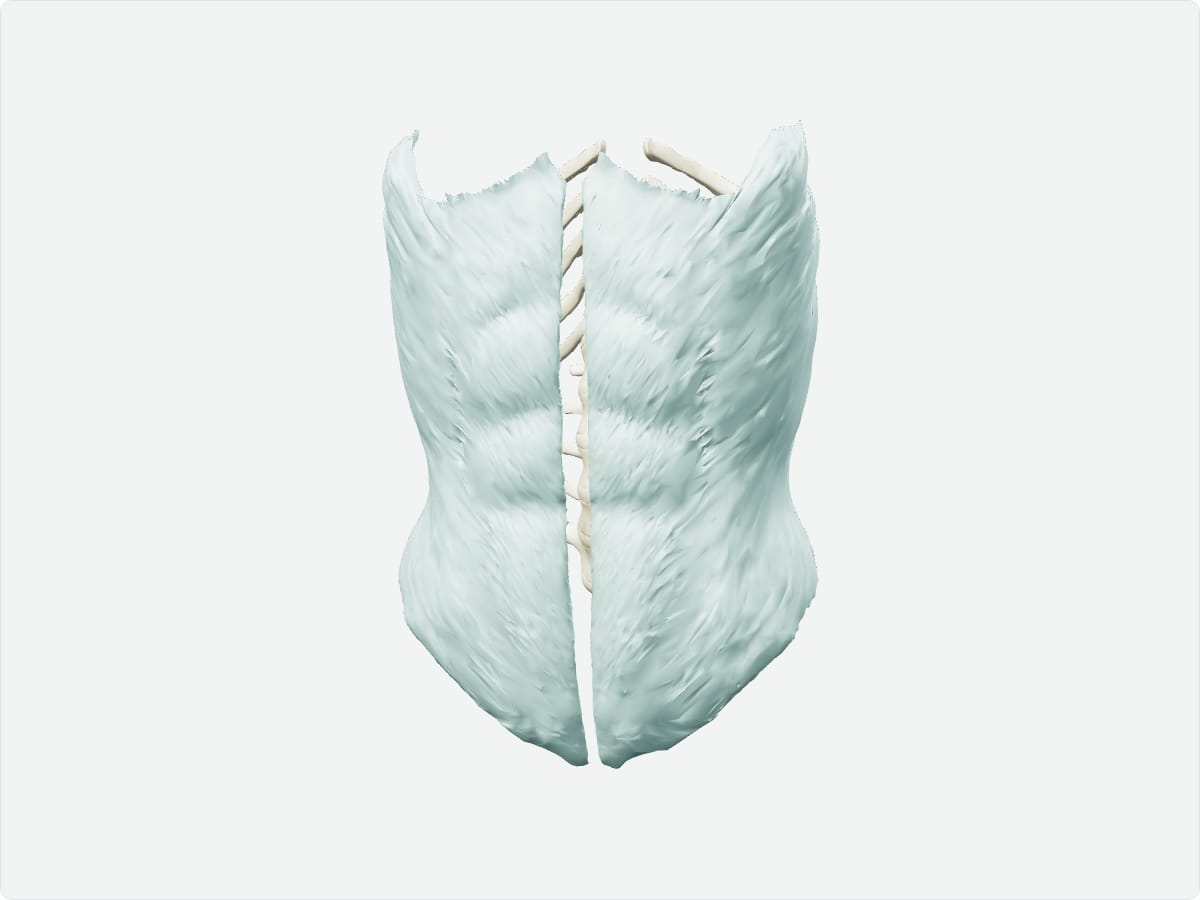
External oblique: origin, insertion, nerve supply and action
Also called: obliquus externus abdominis
Quick answer
The external oblique is the largest and most superficial of the lateral abdominal wall muscles. It arises from the outer surfaces of the lower eight ribs and inserts on the iliac crest and linea alba through an aponeurosis. The lower thoracic nerves supply it, and it flexes and rotates the trunk and compresses the abdomen.
Key facts
Origin
External surfaces of ribs 5 to 12.
Insertion
Anterior half of the iliac crest, pubic tubercle and linea alba through the external oblique aponeurosis.
Innervation
Thoracoabdominal nerves (T7-T11) and the subcostal nerve (T12).
Blood supply
Lower posterior intercostal, subcostal and deep circumflex iliac arteries.
Action
Both sides flex the trunk and compress the abdomen; one side rotates the trunk to the opposite side.
3D model: BodyParts3D (CC BY 4.0), adult male reference anatomy. Highlighted structure shown with nearby bones for context.
About the external oblique
The lower border of its aponeurosis forms the inguinal ligament, and the superficial inguinal ring is an opening in the aponeurosis.
Clinical relevance
Weakness of the aponeurosis near the inguinal canal is involved in inguinal hernias.
Frequently asked questions
Which way do the fibres of the external oblique run?
Downward and medially, in the direction of putting hands in your pockets.
What forms the inguinal ligament?
The lower border of the external oblique aponeurosis.