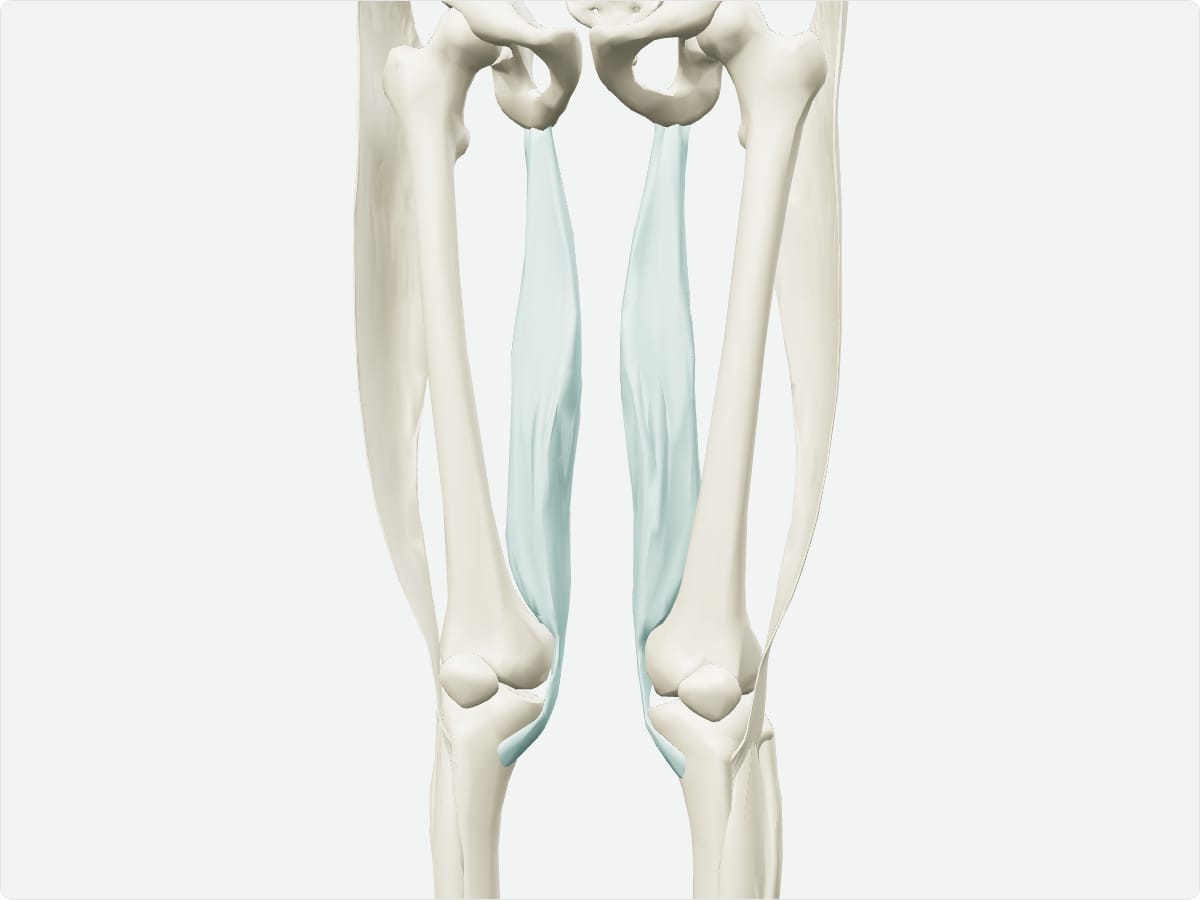
Semimembranosus: origin, insertion, nerve supply and action
Also called: hamstring
Quick answer
The semimembranosus is a hamstring muscle lying deep to the semitendinosus. It arises from the ischial tuberosity and inserts on the posterior aspect of the medial tibial condyle. The tibial part of the sciatic nerve supplies it, and it extends the hip and flexes and medially rotates the knee.
Key facts
Origin
Superolateral aspect of the ischial tuberosity.
Insertion
Posterior surface of the medial condyle of the tibia; expansion forms the oblique popliteal ligament.
Innervation
Tibial part of the sciatic nerve (L5-S2).
Blood supply
Perforating branches of the profunda femoris and the inferior gluteal artery.
Action
Extends the hip, flexes the knee and medially rotates the flexed knee.
3D model: BodyParts3D (CC BY 4.0), adult male reference anatomy. Highlighted structure shown with nearby bones for context.
About the semimembranosus
Its membranous upper tendon is the source of the name. The semimembranosus bursa lies between the tendon and the medial head of the gastrocnemius.
Clinical relevance
Distension of the semimembranosus-gastrocnemius bursa produces a Baker cyst at the back of the knee.
Frequently asked questions
What is a Baker cyst?
A fluid-filled swelling behind the knee, often arising from the bursa between the semimembranosus tendon and the medial gastrocnemius.