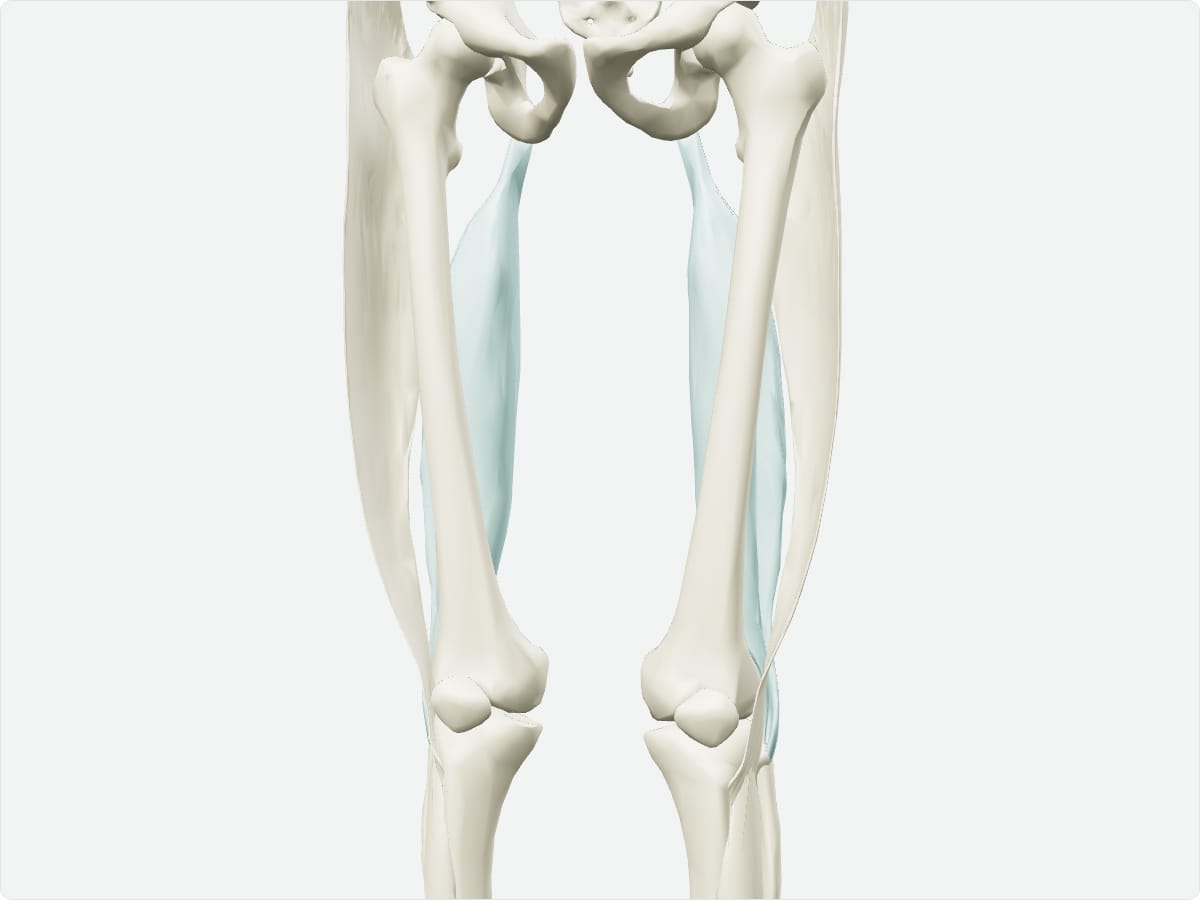
Biceps femoris: origin, insertion, nerve supply and action
Also called: hamstring
Quick answer
The biceps femoris is the lateral hamstring, with a long head from the ischial tuberosity and a short head from the linea aspera. Both insert mainly on the head of the fibula. The tibial nerve supplies the long head and the common fibular nerve supplies the short head. It flexes the knee and the long head extends the hip.
Key facts
Origin
Long head: ischial tuberosity and sacrotuberous ligament. Short head: lateral lip of the linea aspera.
Insertion
Head of the fibula, with a slip to the lateral tibial condyle.
Innervation
Long head: tibial division of the sciatic nerve. Short head: common fibular division (L5-S2).
Blood supply
Perforating branches of the profunda femoris and inferior gluteal artery.
Action
Flexes the knee and laterally rotates the flexed knee; the long head extends the hip.
3D model: BodyParts3D (CC BY 4.0), adult male reference anatomy. Highlighted structure shown with nearby bones for context.
About the biceps femoris
Its tendon forms the lateral border of the popliteal fossa. The common fibular nerve runs along the medial border of the tendon toward the neck of the fibula.
Clinical relevance
Fibular head fractures or tight casts can injure the common fibular nerve and cause foot drop.
The short head is the only hamstring component that does not cross the hip.
Frequently asked questions
Why do the two heads of biceps femoris have different nerves?
The long head belongs to the hamstring compartment (tibial division), while the short head develops from the posterior compartment supplied by the common fibular division.