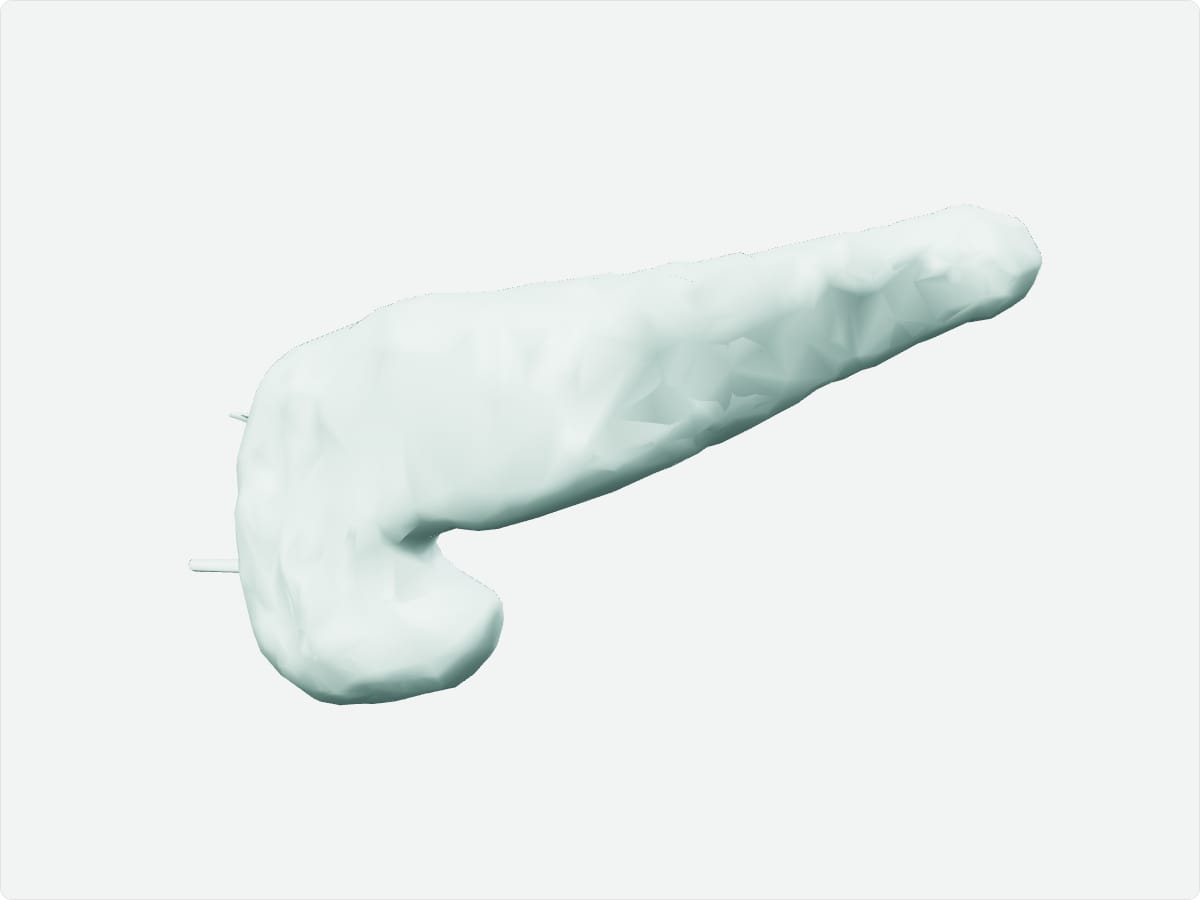
The pancreas is a soft, elongated gland behind the stomach at the back of the upper abdomen. Its exocrine tissue releases digestive enzymes through the pancreatic duct into the duodenum, and its islets of Langerhans release the hormones insulin and glucagon into the blood. It has a head, neck, body and tail.
Key facts
Location
Retroperitoneal, behind the stomach, with the head in the curve of the duodenum and the tail reaching the splenic hilum.
Structure
Head, uncinate process, neck, body and tail; main pancreatic duct and accessory duct; acini and islets.
Function
Exocrine: digestive enzymes and bicarbonate. Endocrine: insulin, glucagon and somatostatin.
Blood supply
Splenic artery, superior and inferior pancreaticoduodenal arteries.
Innervation
Vagus nerve and celiac and superior mesenteric plexuses.
3D model: BodyParts3D (CC BY 4.0), adult male reference anatomy. Highlighted structure shown with nearby bones for context.
About the pancreas
The common bile duct passes through or behind the head of the pancreas before joining the main pancreatic duct at the hepatopancreatic ampulla.
Clinical relevance
Carcinoma of the head of the pancreas can obstruct the common bile duct and cause painless jaundice.
Acute pancreatitis is often caused by gallstones or alcohol.
Frequently asked questions
What are the two functions of the pancreas?
It produces digestive enzymes (exocrine function) and hormones such as insulin and glucagon (endocrine function).