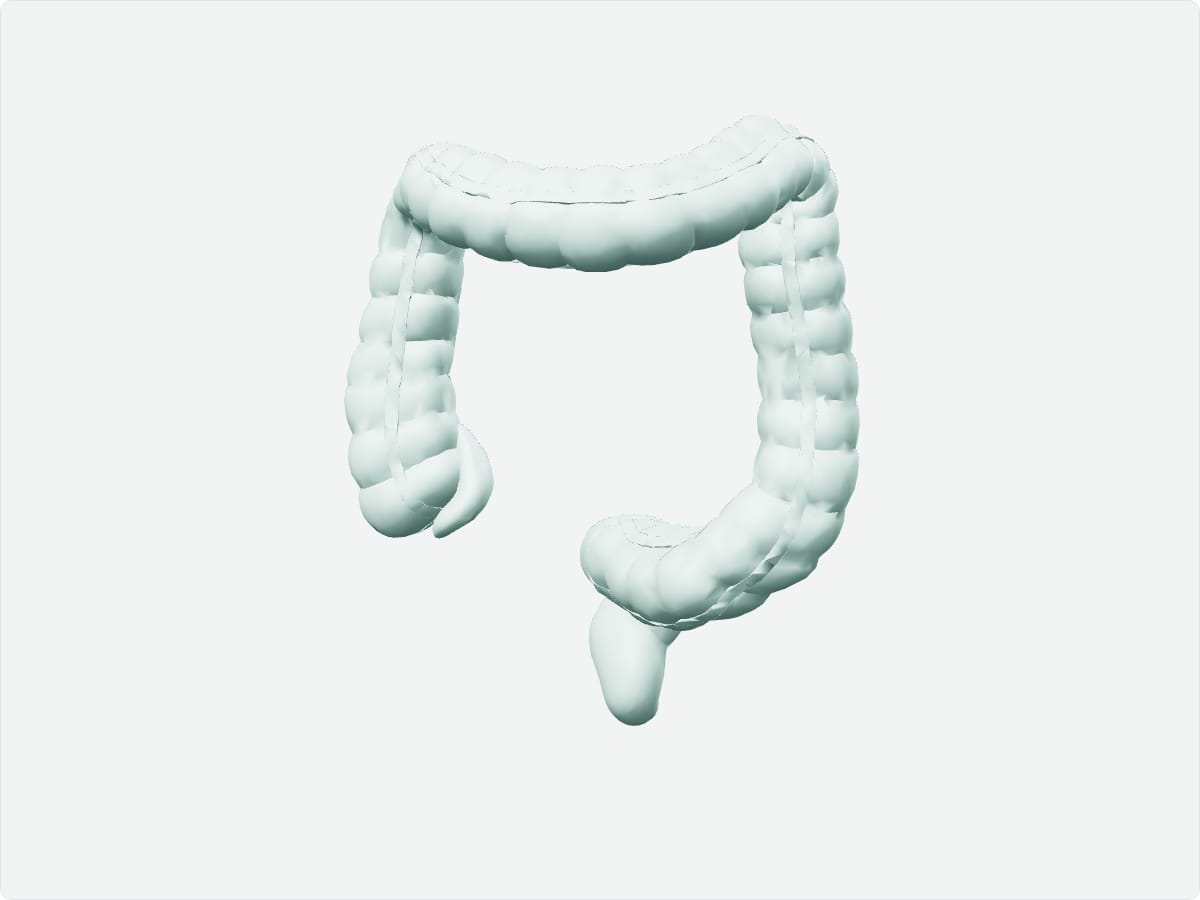
The large intestine frames the small intestine and consists of the cecum, ascending, transverse, descending and sigmoid colon, rectum and anal canal. It absorbs water and electrolytes, forms and stores feces and hosts the gut microbiome. The superior and inferior mesenteric arteries supply it.
Key facts
Location
Around the periphery of the abdominal cavity, from the right iliac fossa to the anus.
Structure
Cecum with appendix, ascending, transverse, descending and sigmoid colon, rectum, anal canal; taeniae coli, haustra and epiploic appendages.
Function
Absorption of water and electrolytes, storage and elimination of feces, fermentation by gut bacteria.
Blood supply
Superior mesenteric artery (to the transverse colon) and inferior mesenteric artery (beyond); middle and inferior rectal arteries to the rectum.
Innervation
Vagus and pelvic splanchnic nerves (parasympathetic), superior and inferior mesenteric plexuses (sympathetic).
3D model: BodyParts3D (CC BY 4.0), adult male reference anatomy. Highlighted structure shown with nearby bones for context.
About the large intestine
The taeniae coli, three bands of longitudinal muscle, are a feature that distinguishes the colon from the small intestine and shorten it to form haustra.
Clinical relevance
Colorectal cancer is one of the most common cancers and is detected by screening colonoscopy.
Diverticulosis usually affects the sigmoid colon.
Frequently asked questions
What are the parts of the large intestine?
The cecum, colon (ascending, transverse, descending and sigmoid), rectum and anal canal.
What is the main function of the large intestine?
Absorbing water and electrolytes and forming feces.