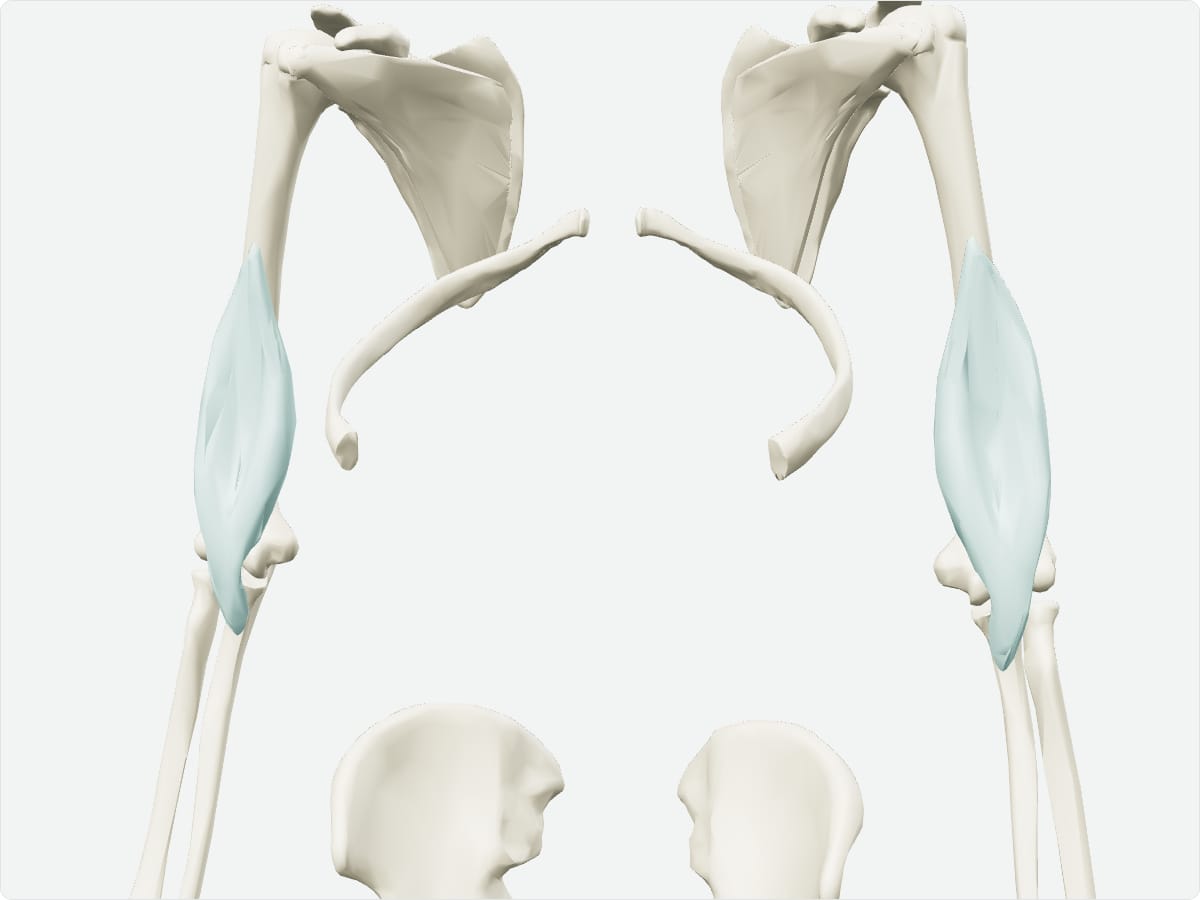
Brachialis: origin, insertion, nerve supply and action
Also called: brachialis muscle
Quick answer
The brachialis is a flat muscle lying deep to the biceps on the front of the humerus. It arises from the distal half of the anterior humerus and inserts on the coronoid process and tuberosity of the ulna. Mainly supplied by the musculocutaneous nerve, it is the primary flexor of the elbow in every forearm position.
Key facts
Origin
Distal half of the anterior surface of the humerus and the adjacent intermuscular septa.
Insertion
Coronoid process and tuberosity of the ulna.
Innervation
Musculocutaneous nerve (C5-C6); the lateral part also receives a small branch from the radial nerve.
Blood supply
Brachial artery and the radial recurrent artery.
Action
Flexes the elbow in all positions of the forearm.
3D model: BodyParts3D (CC BY 4.0), adult male reference anatomy. Highlighted structure shown with nearby bones for context.
About the brachialis
Because it attaches to the ulna, which does not rotate in pronation and supination, the brachialis flexes the elbow regardless of forearm position and is often called the workhorse of elbow flexion.
It forms part of the floor of the cubital fossa and lies between the biceps and the humerus.
Clinical relevance
Its dual nerve supply means that a musculocutaneous nerve injury weakens but does not completely abolish elbow flexion.
Heterotopic ossification (myositis ossificans) after elbow injury commonly involves the brachialis.
Frequently asked questions
What is the action of the brachialis?
It flexes the elbow in every forearm position, making it the main elbow flexor.