Rhomboid major: origin, insertion, nerve supply and action
Also called: rhomboids
Quick answer
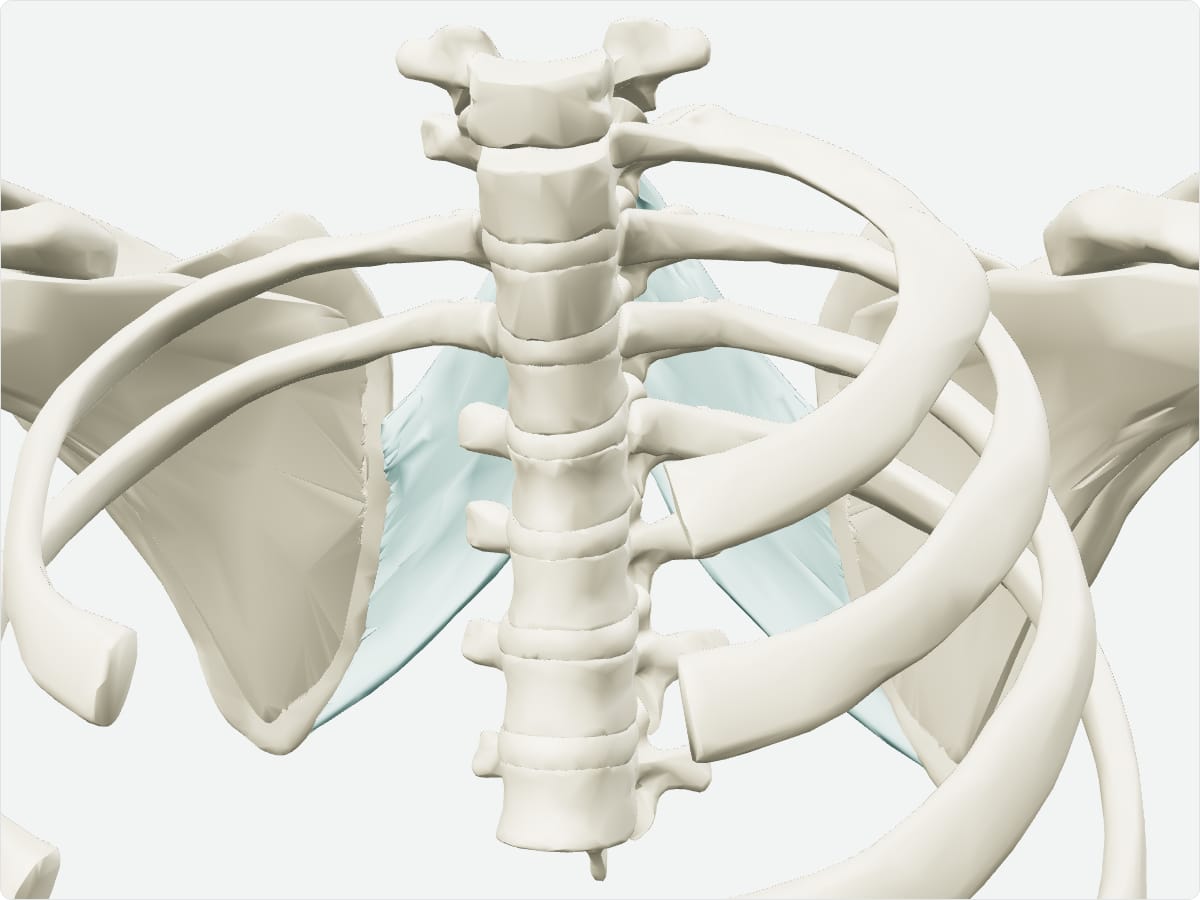
The rhomboid major is a flat muscle between the spine and the medial border of the scapula. It arises from the spinous processes of T2 to T5 and inserts on the medial border of the scapula below the scapular spine. The dorsal scapular nerve supplies it, and it retracts and rotates the scapula downward.
Key facts
Origin
Spinous processes of T2 to T5 and the supraspinous ligaments.
Insertion
Medial border of the scapula between the root of the spine and the inferior angle.
Innervation
Dorsal scapular nerve (C4-C5).
Blood supply
Dorsal scapular artery.
Action
Retracts the scapula, rotates it downward and fixes it to the thoracic wall.
3D model: BodyParts3D (CC BY 4.0), adult male reference anatomy. Highlighted structure shown with nearby bones for context.
About the rhomboid major
The rhomboid major lies deep to the trapezius and sits directly below the smaller rhomboid minor. The two work together as a single functional unit.
They pull the scapulae toward the spine, as in rowing movements.
Clinical relevance
Weak rhomboids after dorsal scapular nerve injury allow the medial border of the scapula to drift away from the chest wall, a mild form of scapular winging that is less obvious than the winging seen with serratus anterior palsy.