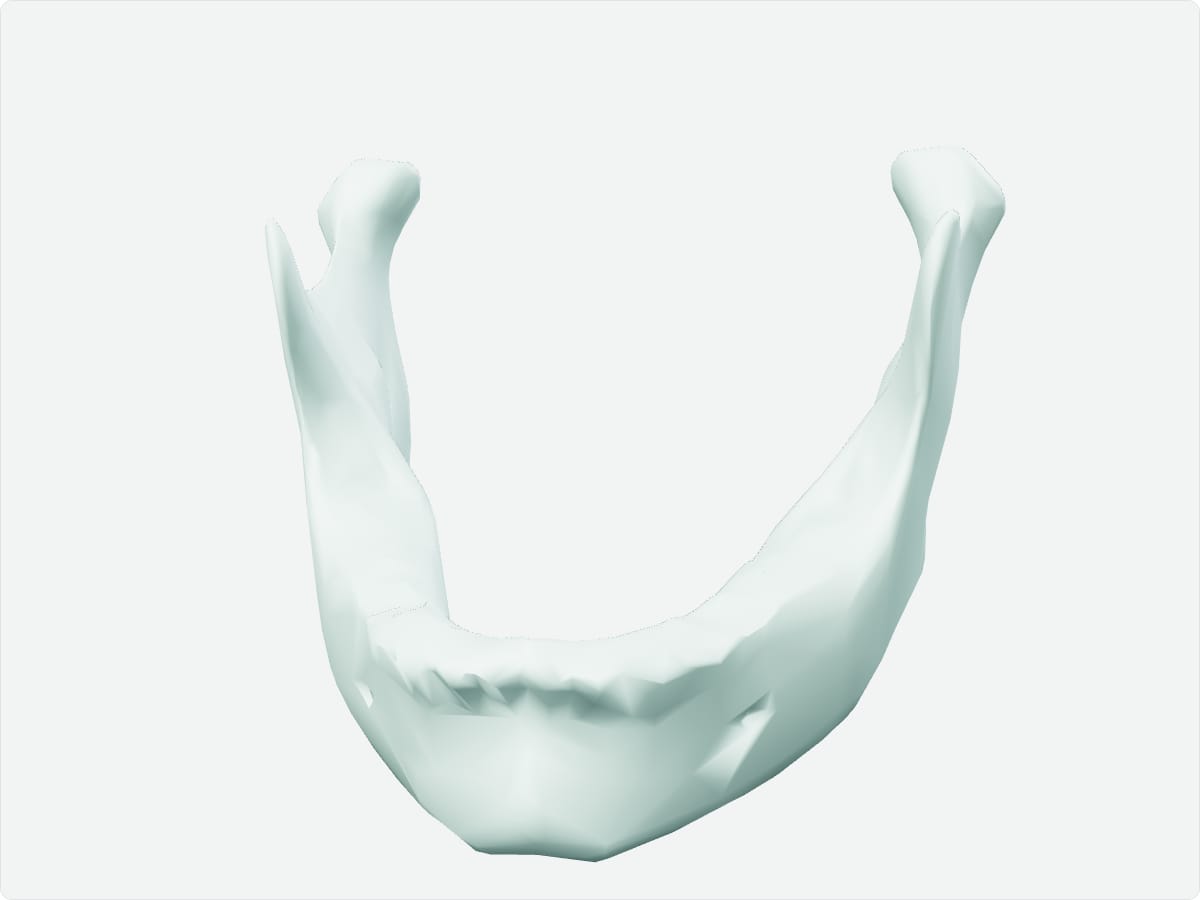
Home / Anatomy / Head and neck / Mandible Quick answer The mandible is the lower jawbone and the only movable bone of the skull. Its horseshoe-shaped body carries the lower teeth, and its rami rise to the condylar and coronoid processes. The condyle articulates with the temporal bone at the temporomandibular joint, allowing chewing and speech.
Key facts Type Irregular bone. Location Lower part of the face. Landmarks Body, ramus, angle, condylar process, coronoid process, mandibular notch, mental foramen, mandibular foramen, alveolar process. Articulations Temporal bones (temporomandibular joints). Muscle attachments Masseter, temporalis, medial and lateral pterygoids, digastric, mylohyoid, geniohyoid.
Explore in 3D 3D model: BodyParts3D (CC BY 4.0), adult male reference anatomy. Highlighted structure shown with nearby bones for context.
About the mandible The inferior alveolar nerve enters the mandibular foramen and leaves through the mental foramen, supplying the lower teeth and chin.
Clinical relevance Mandibular fractures often occur at two sites because the bone forms a ring with the temporomandibular joints. Dislocation of the temporomandibular joint is usually anterior. Frequently asked questions Which skull bone is movable? The mandible, at the temporomandibular joint.
What does the inferior alveolar nerve supply? The lower teeth and, through the mental nerve, the skin of the chin and lower lip.
Draft: this page has not yet been through editorial review. Read our review process .
Last updated September 30, 2026. Educational use only; not medical advice. Sources are listed on the sources page .